
Volunteer Psychologist Leverages Practical Skills in Tanzania
Global Volunteers’ Tanzania partners have skillfully integrated short-term volunteer assistance into ongoing development projects in Tanzania since 1986. While world events cause some volunteers to postpone international service, those who volunteer in the midst of change find that scarcity in “lean times” multiplies the immediate value of their knowledge and expertise. The Lee-Cohen family discovered how significant their personal commitment is in villages whose needs transcend the news-making developments on the world stage. Read and watch psychologist Jacquie Cohen’s account of how she, her husband Tim Lee, a dentist, and their teenaged sons Kieran and Declan contributed their unique skills on their service journey. (First of two parts)
Jacquie learned in pre-departure consultations with U.S. and Tanzanian staff and volunteers how important her professional skills would be in service to the Mental Wellness Initiative. As she departed her home in Vicwagi (Nova Scotia) Canada, she envisioned how her knowledge of human behavior would contribute to training and education in several target areas.
Then she arrived in the host village of Ipalamwa. “I think what I failed to understand is that the foundational science pieces are not there (in local people’s understanding)…in part because of huge misinformation, myths and misinformation in the community,” Jacquie reflected. So, she quickly adjusted her expectations after orientation and her first day of service to more closely match the challenges she observed at home visits in Global Volunteers’ five parter villages.
Describing her in-person consultations with young mothers, she said: “It feels completely surreal, because I’m sitting, you know, this far off the floor on a stool,” with a mother, her children and the Global Volunteers Caregiver in a family’s mud-brick home. “And, you know, we’re in a single room, and the floor is dirt. The wealthier families have a concrete floor.” Initially, she wondered if she had misunderstood her assignment, because what practical help would her advanced psychology degree and expertise offer?
Letting go of a lot of assumptions, I think, is really, really important.”
-Tanzania Volunteer Jacquie Cohen
It didn’t take her long to shed her familiar results-oriented, zipped-up professional style in favor of leaning into her equally comfortable knowledge of parenting and family life – albeit with the benefit of a successful psychology career. “I drew on completely different skills than I thought I would, which is totally fine,” Jacquie reflected.
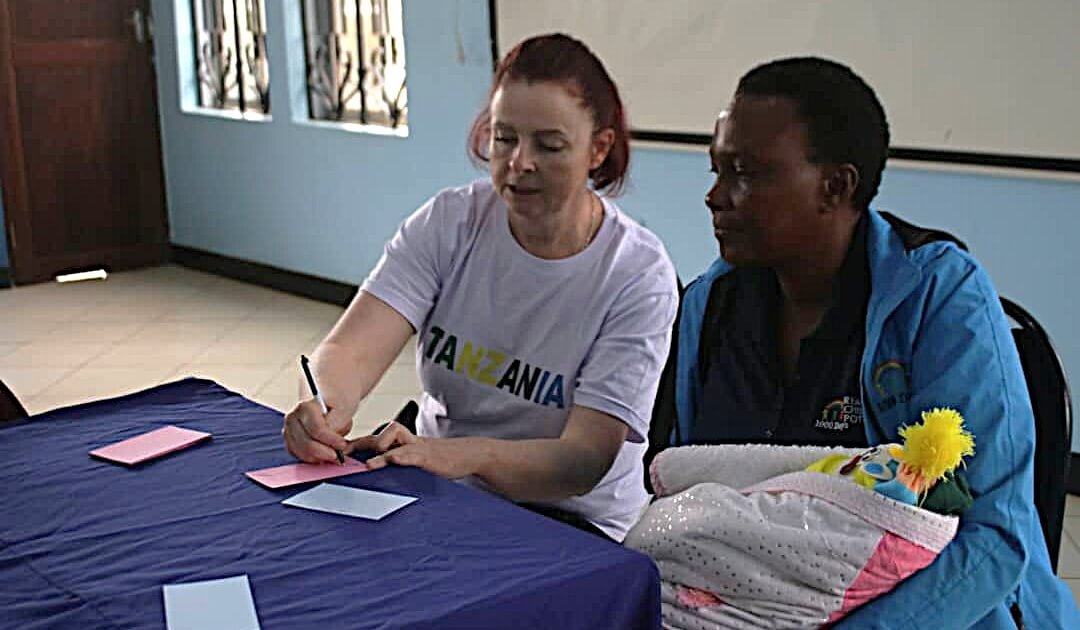
She admits that after deep listening “in the field” she willingly followed a divergent path to meet the critical needs presented to her by Caregivers – local outreach workers who’re trained to recognize mental distress and vulnerability in local families. “And it’s very, very helpful, because you can say to the staff, would this fly here? Would this not? And they’re very good at saying, okay, well, we need to consider this, and we need to consider that.” She said she quickly discovered the areas where social work and psychology differed from how she experiences in her own work environment. “So, you know, letting go of a lot of those assumptions, I think, is really, really important.”
This is where the volunteer professional can gently introduce new and modern ideas, with the guidance of local leaders and staff, meant to reinforce family stability, mental health and nutrition practices, as well as educational interventions in secondary schools. “And honestly, the things I was talking about, I didn’t need a PhD, you don’t need a Master’s in the way we get trained in order to do that. I’m not a child psychologist, and I ended up talking about parenting – (and skills) I haven’t used … in 20 years.”
Overall, she could imagine how each volunteer contributes unique expertise when introducing new concepts and practices which are reinforced by staff. A steady stream of volunteers working with local families over years produces the change required to meet the community’s development goals.
Volunteer “Handoff” Prepared Her for Service
“Lisa’s a psychologist who (served) there, I guess, five months before we were there, Jacquie continues. “And (she’s) just absolutely lovely. So, talking to her, just by virtue of the fact that she was in the same profession as I am, was very, very helpful, because, you know, there’s a certain base level of common knowledge and way of thinking about things. She was fabulous with sharing her materials. She’d done training of first responders around, suicide prevention (in Tanzania). I had a vision that when I sat down with people (in the partner community), there’s a real need (for my skills).
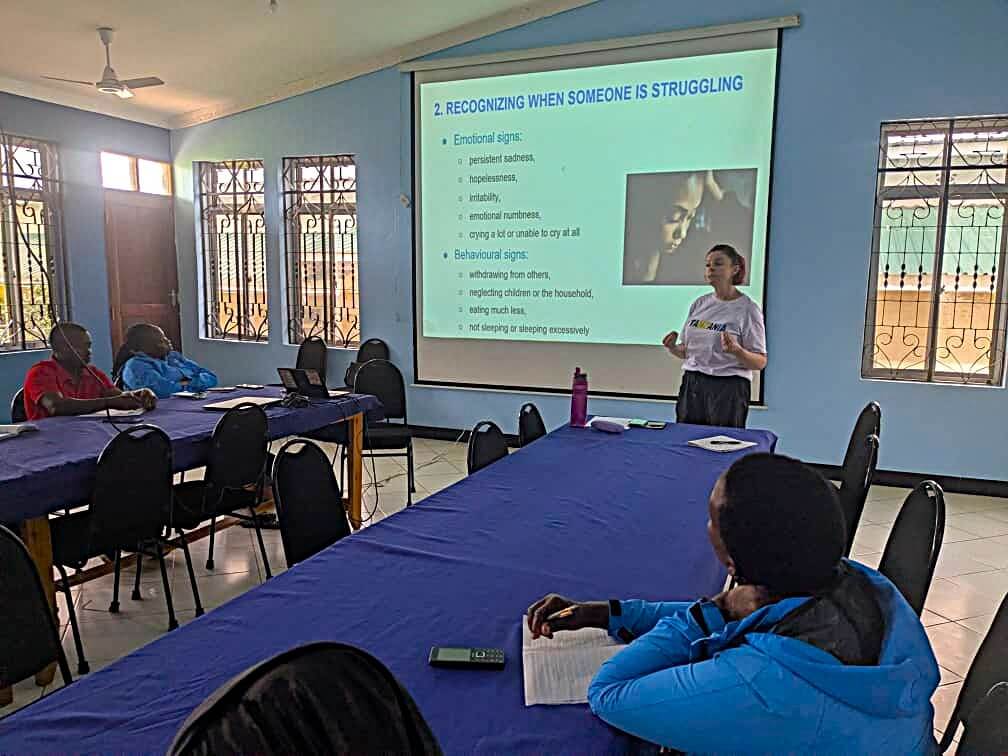
Yet, she said, “you can’t fully prepare for what you’re going to encounter in the field. Some things you’re just not going to know until you’re there.” This is compounded by the fact that a recent decline in volunteer numbers complicates the usual continuity between teams. So, when she arrived, she realized the needs had shifted since Lisa served, and now she would work with mothers who staff Caregivers had identified as depressed and potentially suicidal. And on day three, she and her son, Kieran, were recruited to speak to secondary school students and teachers about Attention Deficit Hyperactivity Disorder (ADHD) and emotional safety.
“I wondered if we were trying to do too much instead of picking a few things to focus on,” she recalled. But by then, she trusted the staff’s ability to maximize her service assignments.
Global Volunteers’ onsite Mental Wellness Education Manager Regina Mhagama reassured her that staff are experts at placing the right volunteer in the right place at the right time. “We explain the rhythm of life and need in the villages is different from what they experience in North America,” she says. “Global Volunteers has served this region of Tanzania since 1986, and our roots are deep. People trust us, and we know their needs in a personal way by working with them every day, every week. The volunteers are a blessing to us whenever they come.” Global Volunteers Caregivers, medical staff and managers know how to seamlessly integrate volunteers into their ongoing work, she says.
Upon reflection, Jacquie agrees. “The staff are amazing in how they work with the volunteers. They reminded us to focus on the basics,” she said. And, that’s not intuitive for the average professional intent on contributing the most they can in a short time. They must remember, she said, the staff are in the community year-round whereas the volunteers serve for two or three weeks. For instance, she acknowledged she had to refer to her early training to prepare for the psychoeducation assignments she offered individually and in groups to women and students over two weeks.
“ I think mental health care professionals in the North America, and Western Europe, we tend to specialize. We tend to get quite advanced knowledge. And we don’t use a lot of the things that we (learned as students). We take for granted a lot of the knowledge that we get early in our training.” She advises future mental health volunteers to “stick to basics.” She added: “What do you want… everybody to know? What you are doing is psychoeducation. And so, the more you can have some basic facts on, depression, trauma, substance abuse, parenting…you think about those basics. Think of those three things that you’d want people to know. And then, of course, think about how to adapt it to the local culture.”
Further, she said: “What I wish I had done more of beforehand is perhaps put together a couple basic presentations. Like, you could take a self-help book and apply the recommendations to (village) women’s lives – because if they can’t see how it’s going to fit in their life, of course they’re not going to use it.” To prove her point, she said in contrast to therapy she may offer a client at home, “there’s no taking a nice long bath and getting a nice coffee and sitting there and reading your book.” Because the busy lives of mothers in rural African villages leave no room for that, she stressed, the therapeutic remedies must be immediately accessible and simple. “Actually, (a lesson on) “mindfulness went over way better than I thought it would. I totally put it out as a gamble, like, and it actually went over really well.”
“A huge part of what we’re doing is giving people permission to talk about things.”
“Previous volunteer professionals – men and women – have come and provided meditation, deep breathing and yoga to our families,” said Regina. “I think it goes over very well because the mothers and fathers who participate in the RCP Program are motivated to learn new ways to improve their lives.” The mothers who attended Jacquie’s session learned from other villagers about previous volunteers’ workshops on psychological reflection and focusing, and were eager to try, she said.
In-Country Staff Guide Local Work Assignment
Jacquie credits Global Volunteers’ model of development, where local leaders define long-term goals, local staff manage work projects, and volunteers provide outside assistance and expertise for producing lasting outcomes. With the focus on mothers and children in the over-arching Reaching Children’s Potential Program (RCP), of which mental wellness is a significant element, she was pleased to see the female RCP Caregivers taking the lead in delivering essential services to families.
“I think women need to see women (staff and volunteers) at work. And I love that they have all these examples with the Caregivers having their multiple roles. They function as kind of the intermediary, the glue there (between the volunteers and the people they serve). And what you have in (Tanzanian Team Leader) Fatina. Now, I cannot say it enough, she is a gem, you know, what she does with the connection between the volunteers, the staff, and the community, and holding that all together.”
Global Volunteers staff’s relationship with local people is critical, she said, to volunteers’ ability to quickly integrate into the community, and to be assured that the knowledge they share is presented in a useful, respectful and culturally appropriate way. This led her to one of the most impactful moments in her two weeks of service.
“I think probably one of the times that touched me the most was, in one of the groups I did with the women, where we were talking about the things that can contribute to depression, and it struck me that nobody talked about traumatic experiences, right? And, and I was like, okay, we need to do a little bit of modeling here. And so I just, you know, referenced my own trauma history in general terms, but just to try and normalize it. And a woman spoke up, and she was tearful. She didn’t say anything about her own experience, she just said, ‘thank you so much, because we never talk about that.’ That’s…like, a huge part of what we’re doing is giving people permission to talk about things, right? Yeah.”
Jacquie said she feels “most proud” of helping to reduce mental stigma associated with trauma in the partner villages. “It opens up the conversation and addresses self-blame and shame that keeps people (stuck). “That’s how we can help women there, yeah. Normalize the topic. I think that’s very powerful.”
“You know, if you were to ask me to summarize it, I’d very much say it was very meaningful, so you should go, and you feel like you’re contributing. You feel like you’re giving a lot because the need is so great, but every little bit you give is a drop in the ocean, you know? It’s very much “both-and.”


Leave a Reply
Want to join the discussion?Feel free to contribute!